
Why You Can’t Just Forgive After Betrayal and Move On
(And Why That’s Not Your Fault)
The research behind why betrayal requires its own healing path — and why the most well-meaning advice may have been making things harder.
If you’ve ever been told to just forgive and move on — this post is for you.
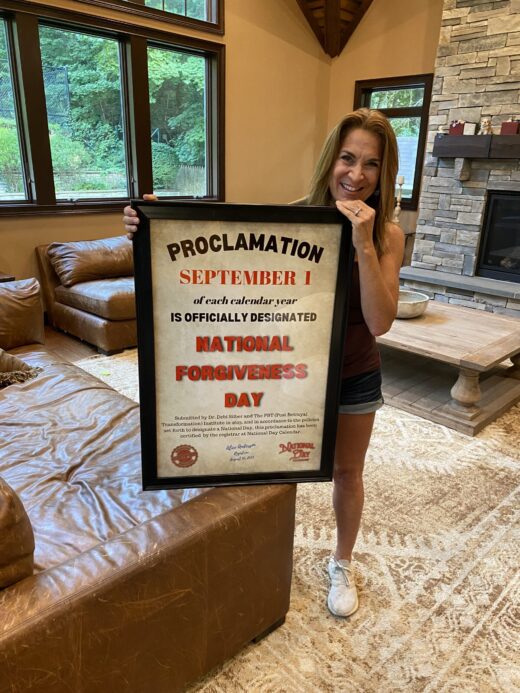
Not because I’m going to tell you that forgiveness doesn’t matter. It does. I believe in it deeply. I believe in it so much that I founded National Forgiveness Day (September 1st).
But I want to say something first that I think you may have needed to hear for a long time.
| The fact that you haven’t been able to forgive and move on is not a character flaw. It is not weakness. It is not a lack of trying. |
The research actually explains why forgiveness — as a starting point — doesn’t work. And once you understand why, I think you’ll finally be able to stop blaming yourself for not being further along than you are.
What the Research Found About Replaying
In our research of more than 100,000 people who have been through betrayal, 80% reported that they constantly revisit the experience — and it brings them little to no relief.
Let me sit with that for a moment.
Not occasionally. Consistently. Constantly revisiting — and getting nothing from it. No closure. No resolution. No peace.
And here’s what matters: these are not people who are choosing to dwell. They are not choosing to stay stuck. They are not weak or wallowing or playing the victim.
Their brain and body are doing something that feels like it should help — but doesn’t.
What’s actually happening in the body
Betrayal doesn’t just leave an emotional wound. It leaves a physiological one.
When someone we deeply trusted violates that trust, the nervous system responds as it does to any significant threat — it activates. The body goes into a kind of alarm state. Hypervigilant. Scanning for danger. Unable to fully settle or feel safe.
And here is the part that most people don’t know: until that alarm is addressed — not just cognitively, not just through understanding or talking it through or deciding to let it go, but through a process that works with how betrayal specifically affects the body and mind — the replaying continues.
| Not because something is wrong with you. Because something is right with you — your system is trying to protect you. It just doesn’t know how to stop yet. |
This is not a metaphor. It is a measurable physiological reality. The nervous system that went into high alert in the moment of discovery does not come down simply because time has passed. It comes down when it receives specific kinds of input — the kind that tells it, with evidence, that the threat has been processed and the wound has healed.
That process is specific. And most approaches to healing — as well-meaning as they are — were not designed with it in mind.
The Problem With ‘Just Forgive’
I want to be careful here, because I am not dismissing forgiveness. I am not saying it isn’t real, valuable, or profoundly important.
I founded National Forgiveness Day (September 1st) because I believe in the transformative power of forgiveness — when it’s genuine, when it’s chosen freely, and when it’s for our own sake rather than as a social obligation.
| The distinction that changes everything
Forgiveness is a destination — not a starting point. It follows a similar timeline as trust. Trust takes time. So does forgiveness. And both of them come as a result of healing — not before it. |
What the research shows is that forgiveness is something that happens as healing progresses. It is not something you can will yourself to feel before the healing has occurred. And attempting to jump to forgiveness before moving through the stages of recovery — however sincere the attempt — tends to produce one of two outcomes.
What happens when people try to forgive too soon
They try. They tell themselves they’ve forgiven. They go through the motions — say the words, write the letter, do the exercise.
And the pain is still there.
And now, on top of the original wound, they feel like a failure. Not just someone who was betrayed, but someone who can’t even do forgiveness right.
| They weren’t failing at forgiveness. They were missing the path that leads to it. |
This is one of the most damaging things the ‘just forgive’ message does — it takes people who are already suffering and adds a layer of self-blame on top of the wound. They internalize the message that their inability to forgive is the problem, rather than understanding that forgiveness cannot be a starting point for healing any more than a finish line can be a starting point for a race.
The Five Stages — Why the Path Is Specific
The research revealed something that I believe has the potential to change how we approach betrayal healing entirely.
Everyone who goes through significant betrayal moves through the same five stages. Different timelines. Different circumstances. Different kinds of betrayal. The same Five Stages of Betrayal Recovery™.
Why this matters
Each stage has its own specific needs. What helps in Stage 1 doesn’t help in Stage 3. What moves someone from Stage 2 to Stage 3 is entirely different from what moves them from Stage 3 to Stage 4. The interventions that are supportive at one stage can actually impede progress at another.
This is why generic approaches — however well-intentioned — often don’t fully work for people who have been through betrayal. Not because the approaches are bad. Because betrayal is specific. And it requires something specific in response.
It also explains something that most people who have been through betrayal already know but have struggled to articulate: why they can do significant therapeutic or personal development work, feel better in many ways, and still feel stuck in a particular place they can’t name or move through.
That stuckness is not evidence of failure. It is evidence of being in a specific stage, with specific needs, that haven’t yet been met. The Five Stages of Betrayal Recovery™ — validated across 100,000+ people in 50+ countries — gives us the map to understand which stage, and what those needs are.
What Forgiveness Actually Looks Like — When It’s Real
I want to come back to forgiveness here — because I don’t want to leave the impression that it doesn’t matter or isn’t possible. It is. And it’s worth describing what it actually looks like when it arrives authentically.
Genuine forgiveness — the kind that actually frees the person doing the forgiving — doesn’t come from an act of will. It doesn’t come from deciding to forgive. It comes from healing. From moving through the stages. From arriving at a place where the original wound has been addressed at its roots — physically, mentally, and emotionally.
When that happens, forgiveness often arrives quietly. Not as a dramatic decision, but as a natural byproduct of the fact that the wound no longer has the same power. The person who betrayed you doesn’t need to have apologized. They don’t need to have changed. Forgiveness, in this sense, is something you do for yourself — a release of the weight you have been carrying on their behalf.
| Forgiveness is not the beginning of healing. It is one of the signs that healing has happened. |
And that reframe — from forgiveness as a starting requirement to forgiveness as a natural outcome — may be one of the most liberating shifts a person healing from betrayal can make. Because it removes the performance pressure. It removes the self-blame. It replaces ‘why can’t I forgive’ with ‘what do I need to heal’ — which is the right question, asked at the right time, in the right direction.
You Are Not Behind
If you have been carrying this for months — or years — and you have tried things that haven’t fully worked, I want to say something to you directly.
You are not behind.
You are not broken.
You are not failing at forgiveness, or healing, or moving on.
You have been healing without a map.
The map exists. It was built through ten years of research, validated across more than 100,000 people in 50+ countries, and it shows — consistently — that every person who has been through significant betrayal has a path through it. Not around it. Through it. And on the other side of it is not just the absence of pain, but something the research describes as genuine transformation.
That path is what The PBT® Institute exists to provide.
| Healing from betrayal isn’t just possible. It’s predictable — when you have the right map. |
| Find out where you are
The free Post Betrayal Syndrome® Assessment will tell you exactly which stage you’re in, what you’re experiencing, and what comes next. More than 100,000 people have taken it. Take the free PBS® Assessment → https://thepbtinstitute.com/pbs-quiz/ Or if you’re ready to begin moving through the stages: Betrayal to Breakthrough: Live is an 8-week live coaching program built on The Five Stages of Betrayal Recovery™. Learn more → thepbtinstitute.com/live |
| Before you go
How long ago was your betrayal? Whether it was last week or ten years ago — drop it in the comments. I read every one. |
| About Dr. Debi Silber
Dr. Debi Silber, PhD is the founder and CEO of The PBT® Institute and the world’s leading expert in betrayal recovery. Her research spans 100,000+ participants across 50+ countries, and her research led to 3 discoveries. Betrayal is a different type of trauma that requires a different way to heal, Post Betrayal Syndrome® and The Five Stages of Betrayal Recovery™. She is a two-time TEDx speaker with 2M+ combined views, the host of the top 1% globally ranked podcast From Betrayal to Breakthrough, and the founder of National Forgiveness Day. She is a two-time #1 international bestselling author. Learn more at thepbtinstitute.com |