
Why Your Most Difficult Clients Aren’t Actually Being Difficult
By Dr. Debi Silber | The PBT Institute | For Family Law & Divorce Professionals
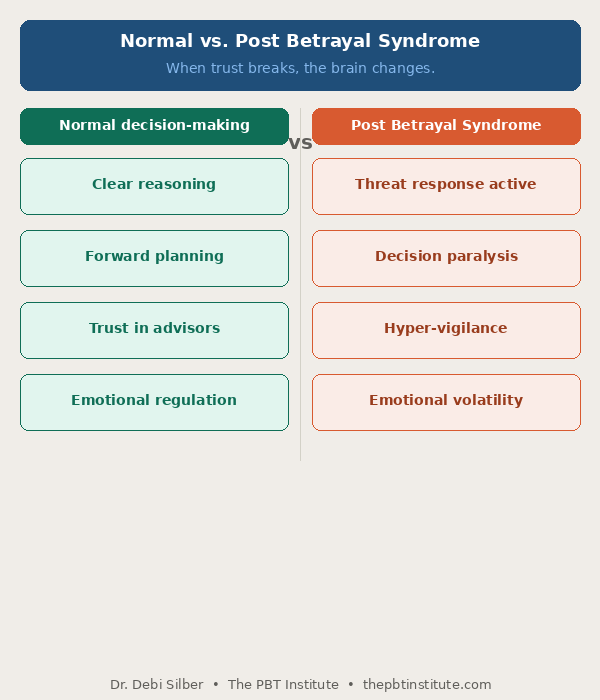
You’ve had that client. The one who turned down a settlement you’d consider a win. The one who suddenly stopped trusting your advice after months of productive collaboration. The one whose decisions seemed to defy logic — and cost everyone time, money, and energy.
Most attorneys, when pushed, will say something like: “They’re sabotaging their own case.” And it can genuinely feel that way. But what if there’s a more accurate explanation — one that doesn’t assign blame, but actually helps you work with these clients more effectively?
My research points to something most legal professionals have never had a name for. And once you have the name, you start seeing it everywhere.
What My Research Found
During my doctoral work, I set out to understand why some people recover from betrayal and others don’t. What I discovered was something more significant: betrayal is a distinct type of trauma. Not just painful — structurally different from other forms of loss or hardship.
I identified a cluster of over 60 symptoms that consistently appear in people who’ve experienced betrayal by someone they trusted. I named this Post Betrayal Syndrome®, or PBS®. It affects how people sleep, how they eat, how they think — and critically, how they make decisions.
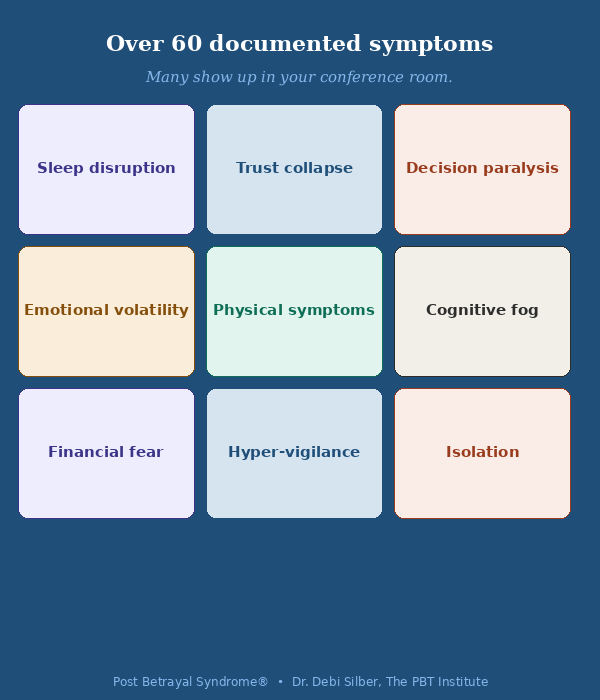
The most relevant symptoms for legal professionals are the ones you’re already watching play out in your conference rooms: inability to trust advisors, difficulty making forward-looking financial decisions, emotional volatility that seems disproportionate, and a persistent sense that something else is wrong even when the facts say otherwise.
This Isn’t a Character Issue — It’s a Neurological One
Here’s what matters most for your work: Post Betrayal Syndrome isn’t stubbornness. It isn’t a personality flaw. It’s a stress response — and it has a predictable pattern.
When trust is broken, the brain enters a prolonged threat state. The nervous system, designed to protect against danger, starts interpreting even neutral interactions as potentially threatening. The prefrontal cortex — responsible for reasoning, planning, and decision-making — gets flooded by the stress response and operates at a reduced capacity.
This is why a client can understand their options intellectually and still feel unable to choose. It’s why someone can agree to terms on a Tuesday and reverse course by Friday. It’s why financial advice that seems perfectly logical lands as suspicious or overwhelming.
The brain isn’t broken. It’s doing exactly what it was designed to do when safety has been compromised. The problem is that legal proceedings require a level of rational forward-thinking that this stress state actively suppresses.
What This Looks Like in Practice
Attorneys and mediators who’ve heard this framework tend to have an immediate reaction: “I’ve seen this in my cases.”
It shows up as:
- A client who was cooperative for months suddenly becoming suspicious of everyone — including you
- Settlement resistance that has no clear legal basis
- Emotional volatility during mediation that derails productive conversations
- An inability to make financial decisions, even straightforward ones
- A client who seems to need the conflict to continue, even when resolution is clearly in their interest
None of these are unusual. They’re predictable — when you understand the framework behind them.
Why This Matters for Your Practice
When you can recognize Post Betrayal Syndrome in a client, a few things change. You stop over-explaining to a brain that can’t process information the way it normally would. You adjust your timeline expectations. You frame decisions differently. You know when pushing harder will backfire.
This doesn’t mean you become a therapist. It means you work smarter — because you understand what’s actually driving the behavior you’re seeing.
The professionals who find this framework most useful aren’t the ones with the most emotionally volatile clients. They’re the ones who were already asking: “Why does this keep happening, and what can I do about it?”
In my next post, I’ll go deeper into one of the most costly patterns in divorce proceedings: the negotiation breakdown that happens right before resolution — and why it’s almost never about the legal issues on the table.
INTERESTED IN BRINGING THIS PROGRAM TO YOUR FIRM OR BAR ASSOCIATION?
Dr. Debi Silber is in collaboration with CLE-eligible programs for bar associations, family law sections, and professional firms. Visit thepbtinstitute.com to learn more.
Dr. Debi Silber, Founder and CEO of The PBT (Post Betrayal Transformation) Institute and National Forgiveness Day, is an award winning speaker, top rated podcast host, and a 2-time #1 International bestselling author. Her PhD study on how we experience betrayal made 3 groundbreaking discoveries that changes everything we’ve known about how to fully heal (physical, mentally and emotionally) from this specific type of trauma. Creator of the #1 betrayal recovery certification programfor life, business, health and leadership coaches, Dr. Debi certifies practitioners globally using her evidence-based framework.