
Why Betrayal Clients Can’t Make Financial Decisions — And What That Costs Your Practice
By Dr. Debi Silber | The PBT Institute | For Family Law & Divorce Professionals
If you’ve ever watched a client freeze on a financial decision that should have been straightforward — a clear-cut asset division, a reasonable settlement offer, a basic question about retirement accounts — you know the frustration.
The facts are on the table. The math is simple. And yet the client cannot move.
This isn’t a failure of intelligence or competence. There is a specific neurological reason betrayal makes rational financial thinking extremely difficult — and understanding it will change how you work with these clients.
The Compounding Effect of Financial Betrayal
In divorce cases involving betrayal, there’s almost always a financial dimension — and often, it’s a compounding one. The betrayal wasn’t just emotional. It included financial deception: a spouse who controlled the accounts, hidden assets, debts that weren’t disclosed, or financial decisions made unilaterally over years.
Even in cases where the financial betrayal wasn’t intentional or dramatic, the loss of trust in a financial partner creates a specific kind of damage. The person who once shared financial decisions with someone now has to make them alone — at the highest-stakes moment of their financial life — while their nervous system is still in a threat response.
The result is what I’ve observed consistently in my research: financial paralysis.
What Happens in the Brain
When trust is broken — particularly financial trust — the prefrontal cortex, which governs planning, future thinking, and rational decision-making, gets flooded by the stress response. This isn’t a metaphor. It’s measurable neurological activity.
Forward planning becomes genuinely difficult. The brain, oriented toward threat detection, struggles to model future scenarios in the calm, analytical way that financial decisions require. Short-term certainty feels more important than long-term optimization. Familiar patterns feel safer than new ones, even when the new ones are objectively better.
For attorneys and divorce financial planners, this translates into specific, recognizable behaviors.
What Financial Paralysis Looks Like in Your Cases
Every one of these behaviors is a direct consequence of what Post Betrayal Syndrome does to the brain’s financial decision-making capacity.
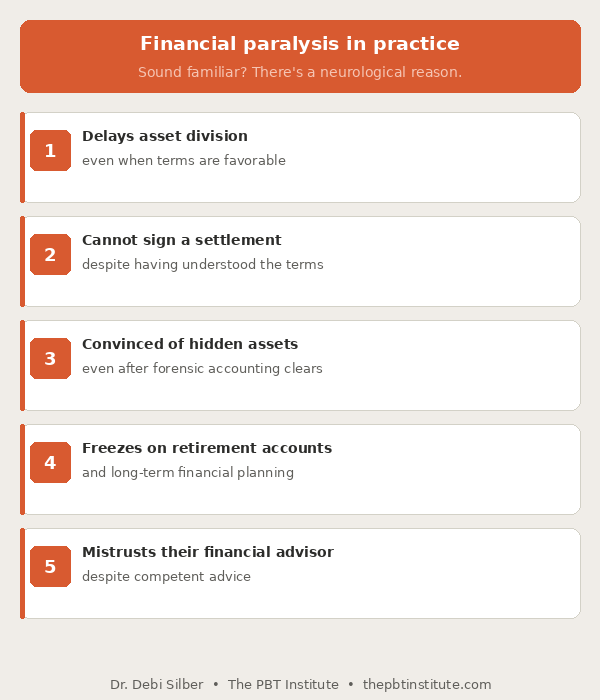
- Clients who delay asset division decisions indefinitely, even when the terms are favorable
- Refusal to sign off on financial settlements despite having reviewed and understood the terms
- Intense suspicion about hidden assets, even after forensic accounting has cleared the books
- Difficulty engaging with retirement account discussions or long-term financial planning
- An inability to trust financial advisors — including their own CDFA — despite competent, straightforward counsel
- Panic responses to routine financial questions during mediation
The Hidden Asset Hypervigilance Pattern
One of the most time-consuming dynamics for attorneys is what I call financial hypervigilance — the pattern where a client is convinced there are hidden assets even when the evidence says otherwise.
This is frustrating for attorneys who’ve done thorough discovery. It can feel like a client who simply refuses to believe the facts. But from a Post Betrayal Syndrome perspective, it makes complete sense.
A brain that was blindsided once — that trusted someone with financial information and was deceived — will not easily accept reassurance. The threat-detection system learned a lesson: trust led to harm. It’s not going to stand down just because a forensic accountant says the books are clean.
Understanding this doesn’t mean accepting indefinite delay. It means knowing what you’re working with — and adjusting your communication strategy accordingly.
What This Means for Divorce Financial Planners
Divorce financial planners often encounter this pattern more directly than attorneys do. Clients who were financially blindsided during their marriage arrive at financial planning sessions carrying a level of fear, suspicion, and overwhelm that rational advice alone cannot address.
The professionals who find this framework most useful are the ones who’ve been asking: “Why isn’t this client responding to good advice?” The answer is almost always trust disruption — not a lack of understanding, not stubbornness, not bad faith.
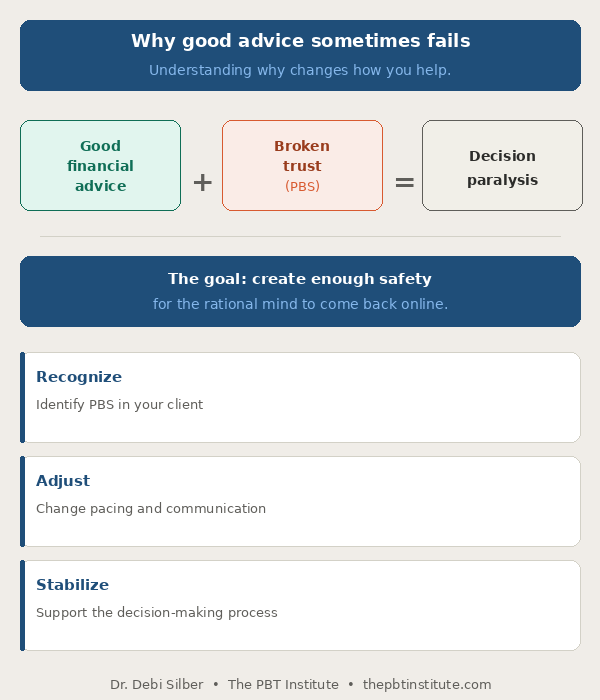
Recognizing the neurological basis of the behavior changes how you sequence information, how you frame options, and how you know when a client needs additional support before they can engage with financial planning effectively.
A Simple Reframe
Here is the most useful thing I can offer legal and financial professionals who work with betrayal clients:
The goal is not to eliminate the fear. The goal is to create enough safety that the rational mind can come back online.
That looks different for every client. But it starts with understanding that what you’re seeing isn’t irrationality — it’s a predictable response to broken trust. When you understand it, you stop fighting it. And when you stop fighting it, things move.
INTERESTED IN BRINGING THIS PROGRAM TO YOUR FIRM OR BAR ASSOCIATION?
Dr. Debi Silber offers CLE-eligible programs for bar associations, family law sections, and professional firms. Visit thepbtinstitute.com to learn more.
Dr. Debi Silber, Founder and CEO of The PBT (Post Betrayal Transformation) Institute and National Forgiveness Day, is an award winning speaker, top rated podcast host, and a 2-time #1 International bestselling author. Her PhD study on how we experience betrayal made 3 groundbreaking discoveries that changes everything we’ve known about how to fully heal (physical, mentally and emotionally) from this specific type of trauma. Creator of the #1 betrayal recovery certification programfor life, business, health and leadership coaches, Dr. Debi certifies practitioners globally using her evidence-based framework.