Why Time Doesn’t Heal Betrayal (And What Does)
If you’ve ever told someone who’s been betrayed to “just give it time,” you may have meant well — but the research tells a different story.
After surveying over 100,000 people on their betrayal experiences, the data is hard to ignore: people are still struggling 15, 35, even 40 years after their betrayal. They describe it as feeling like it happened yesterday. They say they’ll never trust again. Time passed. Healing didn’t.
So if time isn’t the answer, what is?
The Myth We’ve All Believed
We grow up hearing that time heals all wounds. And for many of life’s disappointments, that’s true enough. But betrayal is different. Betrayal doesn’t just hurt — it dismantles your sense of safety, your trust in your own perception, and often your identity. That kind of wound doesn’t close on its own. It needs deliberate, intentional healing.
The same goes for hoping a new relationship will fix it. It won’t. Whatever was left unhealed gets carried right into the next chapter.
Why Even Great Coaches Struggle with Betrayal Clients
Here’s something that surprises a lot of practitioners: it’s not that their tools don’t work. It’s that they’re using the right tools at the wrong time.
Think about what’s happening in the early stages of betrayal. Someone’s nervous system is completely dysregulated — they’re in shock, in survival mode, barely functioning. If you walk in with gratitude exercises or trust-building activities at that stage, you’re not going to get traction. Not because the tools are bad, but because the client isn’t ready for them.
This is why so many coaches dread working with betrayal clients. Their proven methods fall flat and they don’t understand why. The missing piece is a stage-based framework that matches the right intervention to the right moment in recovery.
The Five Stages — And Why Most People Never See the Last Two
The Five Stages from Betrayal to Breakthrough map the journey from the initial shock of betrayal all the way to genuine transformation. But here’s the problem: most people never make it past Stage 3.
Stage 2 is the acute phase — shock, trauma, nervous system chaos. Stage 3 is survival mode. You’re functional. You’re getting through your days. But there’s a flatness to life, a kind of emotional numbness. No real joy. No real forward movement.
And here’s why people stay there: Stage 3 feels better than Stage 2. After the chaos of the initial betrayal, “fine” feels like a victory. It becomes the familiar known — and we are wired to choose the familiar known over the unfamiliar unknown, even when the familiar isn’t actually serving us.
Add to that the fear of disruption — because real healing means new boundaries, speaking up, shaking things up — and the bandwidth issue (some people simply don’t have the mental, emotional, or financial resources to take on more right now), and you have a perfect recipe for staying stuck.
Many people bounce between Stage 2 and Stage 3 for years. Decades, even. Getting thrown down, climbing back up, getting thrown down again. And they assume this is just what life after betrayal looks like.
It isn’t.
The Cost of Staying in Stage 3
Post Betrayal Syndrome doesn’t just affect your emotional life. The body keeps score. Physical illness, chronic symptoms, conditions that seem unrelated — your body communicates through its weakest link, and when unhealed betrayal is sitting in the background, it will find a way to surface.
The symptoms are consistent enough across tens of thousands of assessments that they form a recognizable pattern. Staying stuck in Stage 3 isn’t neutral. It has a cost.
What Stages 4 and 5 Actually Feel Like
Stages 4 and 5 are where hope returns, growth becomes possible, and life starts moving forward again. Most people who are stuck in Stage 3 don’t even know these stages exist — which is part of what keeps them stuck.
Here’s an analogy that captures it well: imagine two friends who are both carrying extra weight. One decides to make a change, does the work, and transforms — feels amazing, confident, energized. The other says, “I’m fine the way I am.” The second friend isn’t lying. They are fine. But they have no frame of reference for how good they could actually feel.
That’s Stage 3. You’re fine. But if you knew for even a minute what Stage 5 felt like, you wouldn’t want to spend another day where you are.
The Path Forward
Healing from betrayal isn’t passive. It requires moving through all five stages with the right support and the right tools applied at the right time. And it’s worth noting that the betrayal you’re aware of often isn’t where the story started — early, unhealed betrayals from childhood or young adulthood frequently underlie the patterns showing up later in life.
The goal isn’t just to help one person heal. It’s to get this framework into enough qualified hands that every certified practitioner can reach everyone in their sphere — because the need is enormous and the waitlist of people searching for this kind of support makes that undeniably clear.
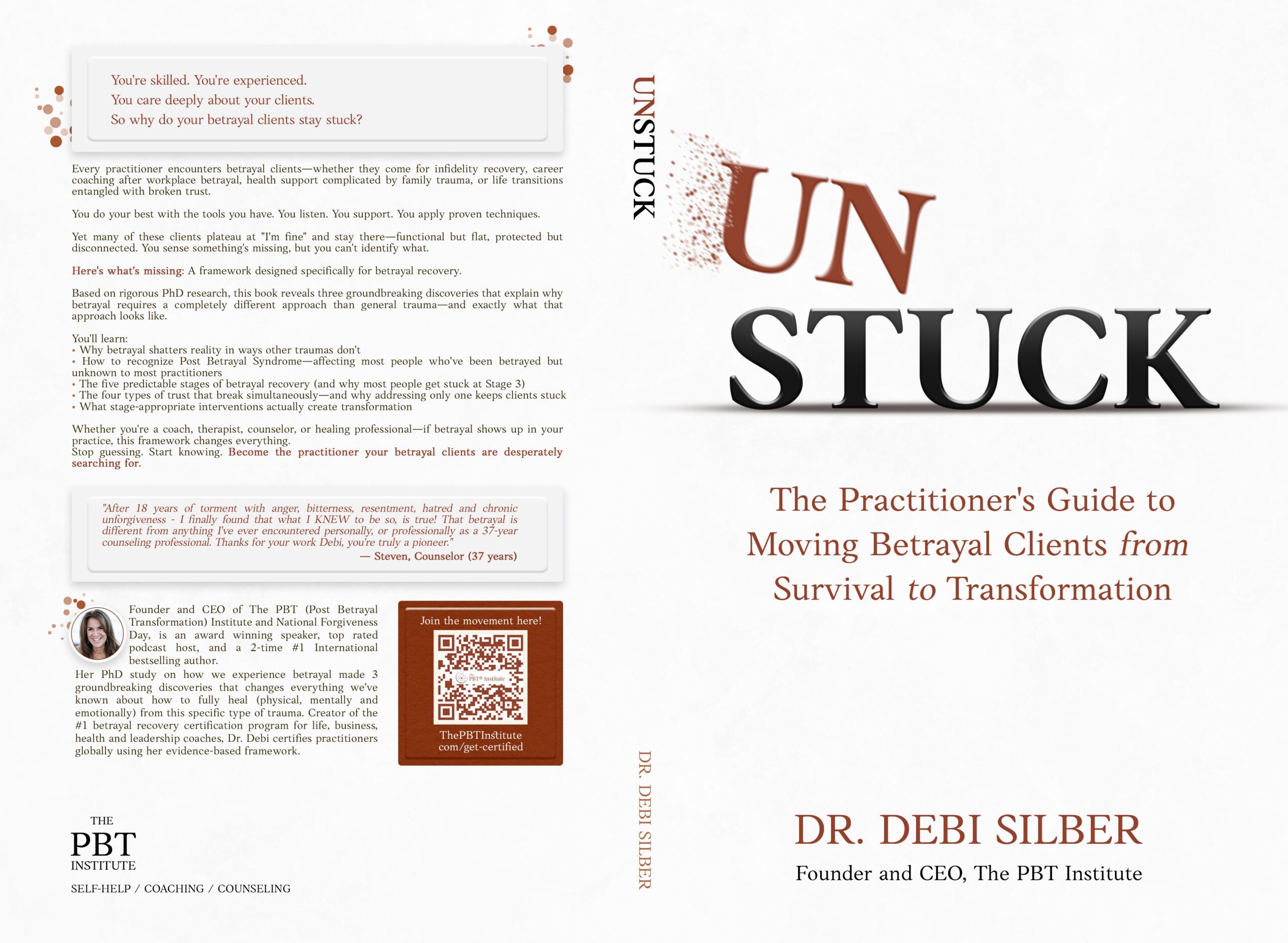
Dr. Debi Silber, Founder and CEO of The PBT (Post Betrayal Transformation) Institute and National Forgiveness Day, is an award winning speaker, top rated podcast host, and a 2-time #1 International bestselling author. Her PhD study on how we experience betrayal made 3 groundbreaking discoveries that changes everything we’ve known about how to fully heal (physical, mentally and emotionally) from this specific type of trauma. Creator of the #1 betrayal recovery certification program for life, business, health and leadership coaches, Dr. Debi certifies practitioners globally using her evidence-based framework.